
I had the great pleasure of joining Mike Tully on his podcast: The Tully Show. We had a wide-ranging conversation about sports ethics and the ethics of sports fandom. Check it out:
https://tullyshow.libsyn.com/shawn-klein-the-sports-ethicist
I had the great pleasure of joining Mike Tully on his podcast: The Tully Show. We had a wide-ranging conversation about sports ethics and the ethics of sports fandom. Check it out:
https://tullyshow.libsyn.com/shawn-klein-the-sports-ethicist
Filed under Fandom, podcast, Sports Ethics
In this episode of Examined Sport, I examine Leslie Howe’s “Gamesmanship.” Published in the Journal of the Philosophy of Sport in 2004, this article quickly became a classic, the go-to article on the topic of gamesmanship. In the article, Howe defines the concept of gamesmanship and analyses the ethical dimensions of gamesmanship in sport.
Subscribe on iTunes:

Available where ever you get podcasts, including Amazon Music and Spotify.
Related Links and Information:
Opening and Closing Musical Credits:
Filed under Examined Sport, gamesmanship, podcast
I recently returned from the IAPS annual conference. This was a special one: the 50th anniversary of the organization. Founded in 1972 as the Philosophic Society for the Study of Sport, it has grown to be the premier philosophy of sport organization in the world. It changed its name to the International Association for the Philosophy of Sport (IAPS) in 1999 to reflect its international stature. In addition to the standard philosophy panels, there was a wonderful celebration of one of the central founders of the society, the late Warren Fraleigh.
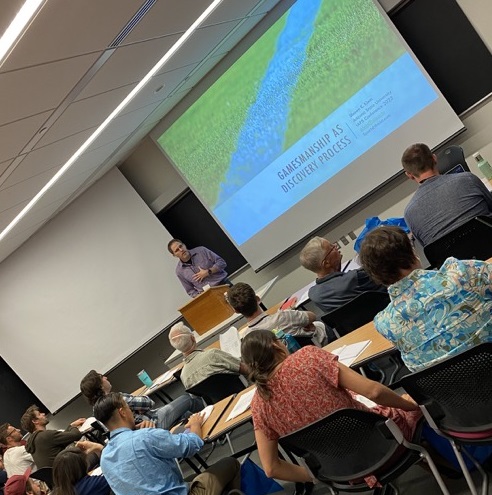 My talk went, I think, really well. I got a lot of great feedback from folks with suggestions for developing the paper further. I was honored to be paired with two great philosophy of sport scholars, Jeff Fry and Nick Dixon. Jeff spoke about free will and Nick about immoral attitudes in sport. Both talks gave me lots to think about.
I chaired a session on ancient philosophy that was really wide-ranging and interesting. The first paper, by Oh-Ryun Kwon and Jeong-Hyo Kim drew some fascinating comparisons between Plato and Confucius on mind-body issues. Breanna McCoy then discussed the interrelations between the concepts of democracy, sport, and philosophy. Lastly, Jenny Schiff examined Aristotle’s virtue of bravery and its application to sport.
I few other highlights:
There were many other terrific talks, and many more I wished I could have attended.
Next year’s conference is in Split, Croatia. It looks to be another great one; the location is amazing. Alas, it’ll likely be too far and too expensive for me to go. But the year after that is in Nova Scotia, so that is much more doable for me.
Filed under Conferences, IAPS
I’m thrilled to announce the publication of the newest book in the Studies in Philosophy of Sport Book Series.
In Sport Realism: A Law-Inspired Theory of Sport, Aaron Harper defends a new theory of sport—sport realism—to show how rules, traditions, and officiating decisions define the way sport is played. He argues that sport realism, broadly inspired by elements of legal realism, best explains how players, coaches, officials, and fans participate in sport. It accepts that decisions in sport will derive from a variety of reasons and influences, which are taken into account by participants who aim to predict how officials will make future rulings.
Harper extends this theoretical work to normative topics, applying sport realist analysis to numerous philosophical debates and ethical dilemmas in sport. Later chapters include investigations into rules disputes, strategic fouls, replay, and makeup calls, as well as the issue of cheating in sport. The numerous examples and case studies throughout the book provide a wide-ranging and illuminating study of sport, ranging from professional sports to pick-up games.
Table of Contents:
About the Author:
Studies in Philosophy of Sport Book Series
Series Editor: Shawn E. Klein, Ph.D. (sklein@asu.edu // sportsethicist@gmail.com )
The Studies in Philosophy of Sport series from Lexington Books encourages scholars from all disciplines to inquire into the nature, importance, and qualities of sport and related activities. The series aims to encourage new voices and methods for the philosophic study of sport while also inspiring established scholars to consider new questions and approaches in this field.
Filed under Books, law, Philosophy, Sports Studies
 A portion of the sale will help me run this site.

 A portion of the sale will help run this site.
 The Sports Ethicist