
If you were not able to attend the Sports and Popular Culture Panel, here’s the video.
Sports and Popular Culture; Faculty Panel Discussion from Arizona State University on Vimeo.
If you were not able to attend the Sports and Popular Culture Panel, here’s the video.
Sports and Popular Culture; Faculty Panel Discussion from Arizona State University on Vimeo.
Filed under Arizona State, Sports Studies
The IAPS meeting at the next Central APA (in Chicago) features Stephen Schmid. In “Reconsidering Autotelic Play” (JPS 36.2) and “Beyond Autotelic Play,” (JPS 38.2), Schmid challenges the view that play necessarily is an autotelic activity and presents his own view of the nature and value of play. The APA panel will revisit and discuss the arguments and ideas raised in these papers. Hope to see you there!
Time: Thursday, Feb 22, 7:40 pm – 10:40 pm.
Topic: The Nature and Value of Play
Chair: Shawn E. Klein (Arizona State University)
Speaker: Stephen E. Schmid (University of Wisconsin–Rock County)
Commentators:
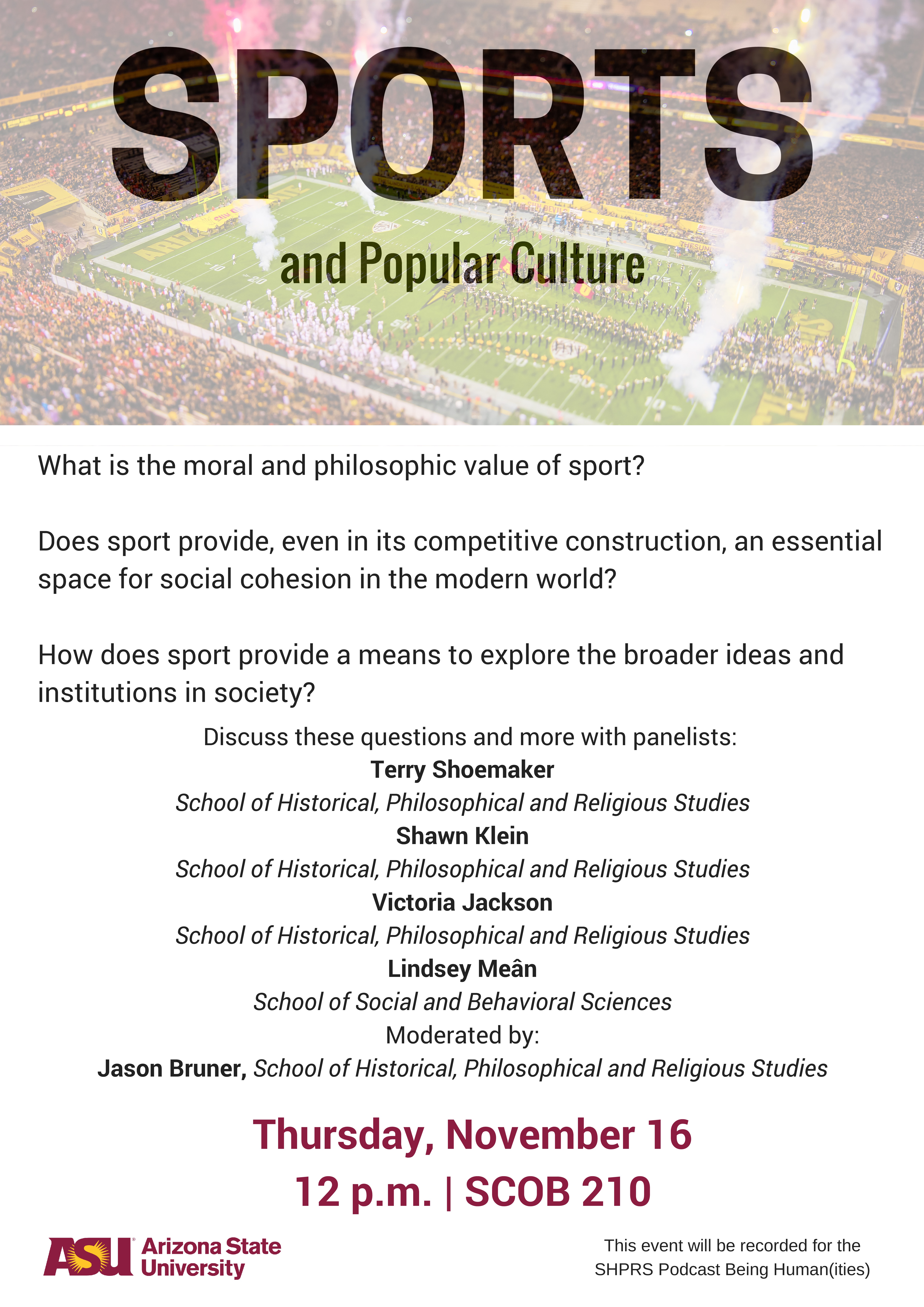 What is the moral and philosophic value of sport?
Does sport provide, even in its competitive construction, an essential space for social cohesion in the modern world?
How does sport provide a means to explore the broader ideas and institutions in society?
Discussion about these questions and more at ASU’s School of Historical, Philosophical, and Religious Studies Sports and Popular Culture Panel.
Moderated by Jason Bruner (School of Historical, Philosophical and Religious Studies).
Panelists:
Date/Time: November 16, 12 pm.
Location: SCOB 210 (620 E Orange St, Tempe, AZ 85281)
Filed under Arizona State, Sports Studies
I’m excited to announce a new online course being offered in Session A of Spring 2018: PHI 394: Philosophy of Sport.
 Course Description:
An inquiry into philosophical ideas and issues in sport. Topics and readings will vary, but may include: the nature and definition of sport, the mind-body relationship in sport, the effects of technology on sport, epistemological issues in officiating, and the aesthetics of sport. Since our “Sports Ethics” course examines ethical issues in sport, this course will not deal with primarily ethical issues.
Likely Topics:
This course counts an upper-division elective credit. Talk with your advisor if you are interested in taking this course.
Filed under Arizona State, Classes, Philosophy, Sports Studies
Idrottsform.org, Nordic Sport Science Forum, published my review of The Ethics of Sport: Essential Readings, edited by Arthur L. Caplan & Brendan Parent (Oxford University Press).
Here’s the opening of the review:
Most of the papers collected in The Ethics of Sport are interesting and informative. They provide insight into many different aspects of the study of sport and of sport itself, and they do so from different disciplinary perspectives.
Nevertheless, this collection as a whole is a disappointment.
Writing a critical, negative review is difficult. There are many things I liked about the book, and I tried to highlight these even as a point out the book’s many flaws.
You can read the rest of the review here: http://idrottsforum.org/klesha_caplan-parent170906/
Filed under Books, Reviews, Sports Ethics, Sports Studies
The International Association for the Philosophy of Sport(IAPS) is holding its annual conference in Whistler, BC, Canada, September 6-9, 2017. I will be attending and presenting. The title of my presentation is “The Value of Play and the Good Life”.
Here’s the abstract:
The dominant conception of play in sport philosophy is that it is must be autotelic. This conception, though, is the subject of some important criticisms. Stephen Schmid argues that the concept of autotelicity admits of many interpretations all of which fail to provide a clear and accurate picture of what play is. Randolph Feezell argues for a pluralistic conception of play, calling for us to acknowledge the variety of meanings and usages of play when we theorize about it. This pluralism seems to push back on the idea that play must always be autotelic and non-instrumental. Additionally, it is worth noting that the empirical literature on play focuses primarily on the external and instrumental benefits that play provides.
With these and other criticisms in mind, my paper seeks to move the discussion of play beyond the dichotomy of autotelicity and instrumentality. Even though most theorists acknowledge that players have mixed-motivations, purposes, and goals, there still is a tendency to treat autotelicity and instrumentality as exhausting the options for categorizing play. The underlying implicit assumption is that it must be either autotelic or instrumental: done for its own sake or done for the sake of something else. This assumption ignores or downplays a third possible category: an activity that is chosen for its own sake and at the same time chosen for the sake of something else.
Drawing a parallel to the role virtue and friendship have in a broadly construed (neo-) Aristotelian ethics, I argue that play is an important part of the good human life. Like virtue and friendship, play is chosen both for the sake of its importance to the good life and for its own sake. It is partly constitutive of the good life and thus chosen as part of and for the sake of the good life. At the same time, however, play is chosen for its own sake: for what it is distinct from any further ends it might bring about. Thus, play is not autotelic, but nor is it instrumental.
Recognizing play as a constituent value of the good life will allow us to integrate the internal and external, the autotelic and instrumental, and gain a better understanding of the value of play.
Filed under Conferences, Philosophy, play
This episode looks at Bernard Suits’ classic paper “Words on Play,” in which Suits attempts to provide a definition of play. While sport and play are not the same thing; examining one yields insight for the other.
Subscribe on iTunes:

Related Links and Information:
Opening and Closing Musical Credits:
Filed under Uncategorized
I’m excited to announce the publication of my article, “An Argument against Athletes as Political Role Models” in the latest issue of FairPlay, Journal of Philosophy, Ethics and Sports Law.
Article abstract:
A common refrain in and outside academia is that prominent sports figures ought to engage more in the public discourse about political issues. This idea parallels the idea that athletes ought to be role models in general. This paper first examines and critiques the “athlete as role model” argument and then applies this critique to the “athlete as political activist” argument. Appealing to the empirical political psychological literature, the paper sketches an argument that athlete activism might actually do more harm than good.
This was part of a special issue on Colin Kaepernick. My article doesn’t really focus on Kaepernick that much–he’s more of a jumping off point for the argument I want to focus on. The other articles in the issue look much more closely on the case of Kaepernick. It’s fair to say, my take is not the consensus view.
You can download and read the article (PDF): An Argument against Athletes as Political Role Models
Full Citation: Shawn E. Klein (2017): An Argument against Athletes as Political Role Models, Fair Play. Revista de Filosofía, Ética y Derecho del Deporte, vol. 10.
An earlier version of this paper was originally presented at Penn State’s Center for the Study of Sports in Society’s Sports Ethics Conference.
Filed under athletes, publications, role models
In this episode of Examined Sport, I discuss Edwin Delattre’s 1975 paper: “Some Reflections on Success And Failure in Competitive Athletics.” This papers stands out for the distinction between winning and success; and losing from failure. It is also one of the earliest accounts of the logical incompatibility thesis.
Subscribe on iTunes:
Related Links and Information:
Opening and Closing Musical Credits:
Filed under Cheating, competition, Examined Sport, Fouls
A Call for Papers for a special issue of Sport, Ethics and Philosophy is out. The topic: “Bernard Suits’ Legacy: New Inspirations and Interpretations.”
The editors of the special issue: Filip Kobiela, José Luis Pérez Triviño, and Francisco Javier López Frías
The special issue is dedicated to philosophical and moral questions related to Bernard Suit’s legacy.
For more information and details, including possible topics and submission instructions: http://philosophyofsport.eu/sport-ethics-and-philosophy-special-issue-bernard-suits-legacy-new-inspirations-and-interpretations/
Filed under CFP


 A portion of the sale will help me run this site.


 A portion of the sale will help run this site.
 The Sports Ethicist