The Sports Ethicist Show: Baseball Wrap

The Sports Ethicist Show airs tonight (Monday 11/18/13)  at 6 pm CDT on Rockford College Radio.

The 2013 baseball season is in the books. Regular listeners know that I am Red Sox fan and my frequent co-host, Mike Perry, is a Cardinals fan. The Sox and the Cardinsals met in the 109th Fall Classic, so it only seems right that Mike and I do a show about the World Series. We also discuss the MLB annual awards.

Listen Here:

Leave a comment

Filed under baseball, podcast, RadioShow

New Course: PHIL 340 Philosophy of Sport

phil of sport-thumb
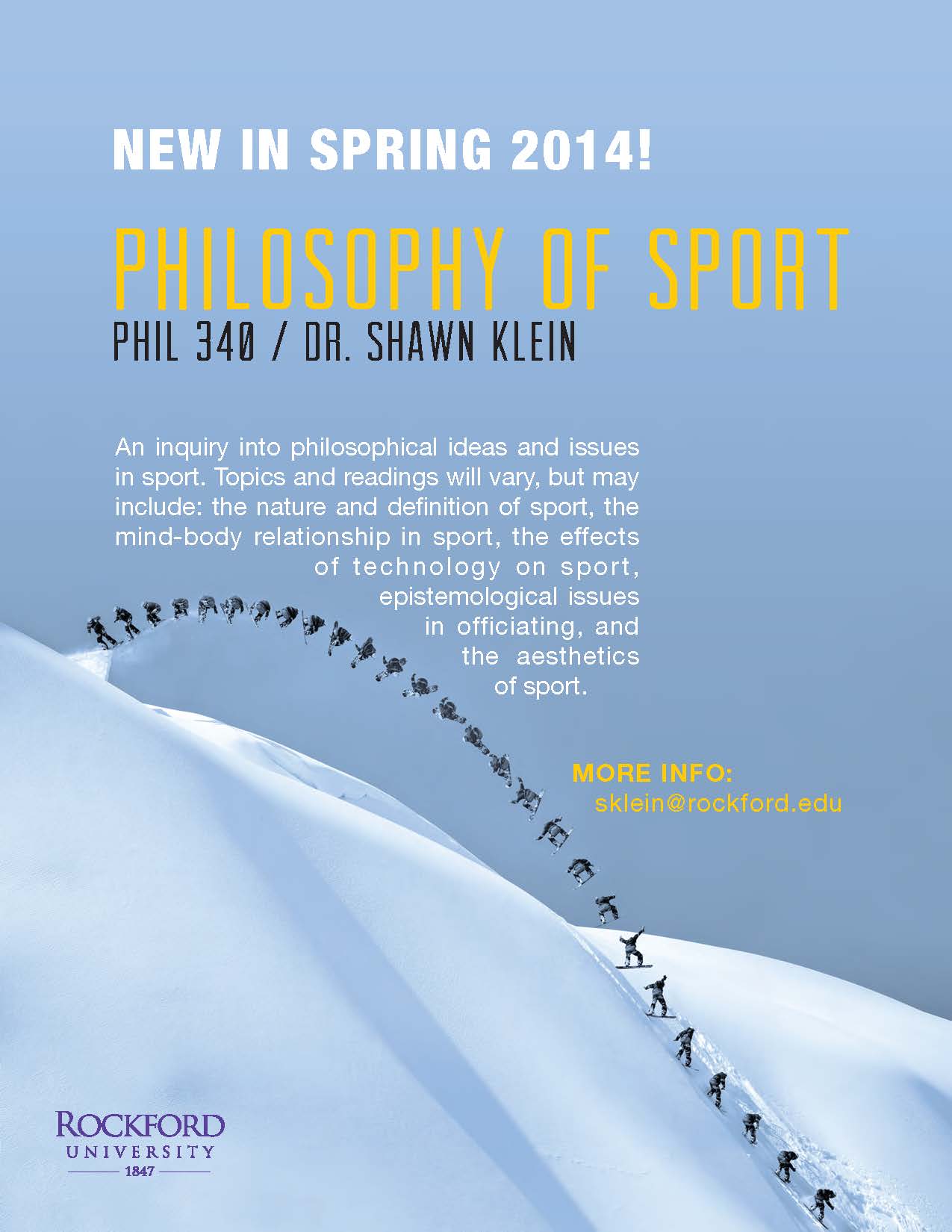
The Rockford University Philosophy Department is offering a new course this spring: PHIL 340 Philosophy of Sport.

Course Description:

An inquiry into philosophical ideas and issues in sport. Topics and readings will vary, but may include: the nature and definition of sport, the mind-body relationship in sport, the effects of technology on sport, epistemological issues in officiating, and the aesthetics of sport.

The course will be using Heather Reid’s Introduction to the Philosophy of Sport (Elements of Philosophy) as well as supplemental articles from the philosophy of sport literature. The course does carry a pre-requisite of a previous philosophy class. Of course, if you have taken my Sports Ethics class, then you have satisfied this requirement.

The course meets T/TH, 1-2:15 pm. Please contact me if you have any questions about the course.

Leave a comment

Filed under Philosophy, Rockford College, Site Announcements, Sports Studies

Welcome Sports Illustrated readers!

This blog was mentioned in Phil Taylor‘s “Point After” column in the October 14, 2014 edition. Taylor’s column focused on the apparent growing tolerance for cheating. He quoted from my post “The Biogenesis Scandal and PEDs“.

When and if Sports Illustrated puts the column online, I will link to it. 

Update 10/23/2013: The column is now online: Rules Are Meant To Be … Rules

Leave a comment

Filed under PEDs, rule-violations

The Sports Ethicist Show: Work and Play

The Sports Ethicist Show airs tonight at 6 pm CDT on Rockford College Radio.

How should we understand the relationship between Work and Play? Are they mutually exclusive activities? What about professional athletes who appear to be play for work? Shawn E. Klein and Bobby Fernandez, of MovingforWellness.com and California State University-Fullerton, discuss these questions and more as they build off their recent papers given at the International Association for the Philosophy of Sport conference in September.

Related/Discussed Links:

Listen here:

Leave a comment

Filed under play, podcast, RadioShow, Uncategorized

Player vs Theory

One of the more common experiences of teaching sports ethics is the eye-rolling response of students. The theoretical account of some issue (e.g. intentional fouls or the proper ends of sports) is met with a cynical glare or what I call the “yeah, but…” response. As in: “Yeah, sounds good in theory, Prof, but that’s not the way it really works.”

For example, Robert Simon defines sport as “the mutual quest for excellence.” On this view, athletes and participates are guided, constrained, and motivated by this cooperative quest for achievement and excellence at the skills and practices of the sport. Overly aggressive play or cheating undermine this quest and so are prohibited. Players play hard in order to achieve their own excellences but also to provide the challenge to their opponents so that they might be pushed to achieve their excellences. There is a lot appealing about Simon’s account. I particularly like the emphasis on the fundamental cooperative nature of athletic competition. But a common student response is “Yeah, that sounds all nice and such, but I play to win. Excellences, challenges, whatever: I want to win.”

Or, in the discussion of intentional fouls, we discuss the range of principles that theorists like Simon and Fraleigh argue ought to constrain a player’s actions in regard to intentional fouls. While Fraleigh is far more restrictive than Simon and others, most share the view that there is something wrong when a player strategically uses explicitly prohibited actions to gain an advantage or negate an opponent’s advantage. The typical student-athlete response is again “Yeah, that sounds all nice and such, but I am going to do what it takes to win the game.”

This might just be that the typical student is unwilling to move from or challenge their pre-reflective beliefs, that they are too cynical or too uncritical to consider accounts that defy the standard narrative. There is a lot of truth to that (a lot!). But at the same time, I think there is something more going on here that needs attention.

While I see this phenomenon in most of the philosophy classes I teach, it is more acute in Sports Ethics. Most of the students are or have been serious athletes. Unlike say in business ethics or biomedical ethics where the students have little or no direct experience with the issues being discussed, the students in sports ethics have a lot of practice in the field under examination. This gives the students a perspective that is typically not there in with students in other classes. (For example, I see something similar when I teach business ethics in my school’s degree completion program where I have students who are already in the business world.)

When the disconnect between students and theory occurs here, it suggests to me something more than mere student stubbornness. These students are practitioners. They may not have given the issue a lot of deep thought, but it is not something new to them. They have views on the issue at hand that have developed from experience, not just the floating uncritical acceptance of a social norm (like minimum wage laws help the poor or everyone ought to vote). Dismissing the rejection of the theoretical-norm as mere cynicism or lack of reflection potentially misses something important.

This is not to argue that we merely ought to accept the player-norms. That would be to shift philosophy to something just descriptive. But I think philosophers and theoreticians ought to pay attention when practitioners in the fields they are analyzing reject the theories. This could point to errors in the theory or a misunderstanding of the practice by the philosophers. It might very well just be student cynicism or lack of criticalness but we don’t really know that unless we look more at the rejection by the players.

Practitioners, too, should pay attention to the theory and not just assume that because they play sports they know what the best account is. Where the theory conflicts with their own practice, it might point to ways in which one is mistaken about their own norms. At the very least, it provides an opportunity for the player to consider in new light what is that he or she is doing.

 

Leave a comment

Filed under Philosophy

The Sports Ethicist Show: Boston Sports

The Sports Ethicist Show airs tonight at 6 pm (Central) on Rockford College Radio.

In town for a Cubs game, Joe Danker joins Shawn E. Klein in the studio to discuss things Boston Sports. Focusing mostly on the Red Sox and their remarkable turnaround from last year, they also hit on the Patriots and make some World Series predictions.

Listen Here:

Leave a comment

Filed under baseball, Boston, Football, podcast, RadioShow

Brief Review: Contemporary Athletics and Ancient Greek Ideals


Daniel Dombrowski’s book, Contemporary Athletics and Ancient Greek Ideals, is very interesting and covers a lot of good material in the philosophy of sport. He is clearly well-versed in Ancient Greek philosophy and the philosophy of sport. So there is a lot to be gained by reading this book.

Truth be told, however, I was a bit disappointed. I think, based on the title and the book descriptions, I expected to find much more in the way of Ancient Greek philosophy. There is a lot, so this might be an unfair criticism, but the focus is really on contemporary philosophers of sport and their theories. The Ancient Greeks are called forth to cast insight, background, and further elaboration, but they are not the focus. Nevertheless, I did learn a lot about the relevancy of the Ancient Greek ideas, particularly of Plato, to some of the issues that arise in the philosophy of sport.

Dombrowski’s discussion of Weiss, Huizinga, and Feezell is helpful and thorough. These are not mere recapitulations. He provides clear insight in to the theories of these thinkers and their impact on the philosophy of sport. He criticizes where he disagrees, though I would have preferred even more critical analysis (that said, this would have lengthened the book beyond the easily digestible size it is). The last chapter on process philosophy was less interesting to me and seemed somewhat misplaced in the context of the other chapters.

Overall, I definitely recommend this. It is not long, is clearly written, and it provides a good discussion of some of the major issues in the philosophy of sport.

Leave a comment

Filed under play, Reviews

The Sports Ethicist Show: Fandom Origins

The Sports Ethicist Show airs tonight at 6 pm (Central) on Rockford College Radio.

Most fans are fans of a team because of geography. But not everyone becomes a fan that way. Sean Beckmann and Mike Perry join The Sports Ethicist, Shawn Klein, to discuss their fandom-origins and other issues in being fans.

Listen Here:

Leave a comment

Filed under Fandom, RadioShow

Brief Review: _Fantasy Life_ by Matthew Berry


Matthew Berry’s new book, Fantasy Life: The Outrageous, Uplifting, and Heartbreaking World of Fantasy Sports from the Guy Who’s Lived It is aptly titled. The stories are outrageous; some are downright insane. They are uplifting, both in the sense of being funny but also in the sense of being sweet and heartwarming. There are more than a few heartbreaking stories included as well. I admit I was moved to tears a few times (but any story involving dads&kids will do that to me!). And lastly, Berry structures the book with his own unlikely and funny biography of how he got into the business of fantasy sports.

Fantasy sports are certainly not for everyone (what recreation is?) but for those who have played casually or obsessively, Berry’s book lets you know that you are not alone in enjoying it–and that more than likely there is some one way more crazed and obsessed than you! And if you are friend, family member, or spouse of a fantasy player, this book can give you a bit of insight into why he or she plays fantasy.

The single biggest focus of Berry’s book, and this is something Mike and I brought up in The Sports Ethicist Podcast and Dr. Andy Koehl brought up in his symposium talk, is that fantasy sports is something that brings people together. Old friends, college buddies, families, co-workers all come together to play fantasy sports of various kinds. As Berry says:

…the truth is it’s all about the people. It’s not the draft, it’s not the trash talk or the punishments, it’s not even the winning (okay, maybe it’s a little bit the winning). It’s the people. It’s the people who make the draft and the trash talk and the punishments and the winning what it is.

This is a big part of why so many people play fantasy (over 30 million in US and Canada). It is fun and it is a community. Much of Berry’s book are just the stories of people having fun and partaking in this fun within a community of folks who share the fun (and the winning!).

Now, you don’t have to be a hard core fantasy player to appreciate this book, but, be careful, you might want to be when you are done.

1 Comment

Filed under Fantasy, Reviews

A-Rod, Dempster, and Beanballs

My readers, listeners, friends, and students all know I am a Red Sox fan. I am from Boston and root for all things Boston sports. I also do not like Alex Rodriguez. I am glad the Sox dodged that bullet in the failed trade for “A-Rod” in 2003. I am not a fan A-Rod more because of his on-field tactics (slapping at Arroyo’s glove and shouting “Mine” while rounding third to confuse the defense) than his alleged PED use. His public, off-the-field personality is not one Dale Carnegie would likely recommend. If the charges prove true regarding A-Rod’s PED use and obstruction of MLB investigations into Biogenesis, that certainly adds to my (and many other’s) disdain for him.

All this said, I do not think Ryan Dempster should have (if he did—and for the purposes of this post, I will assume he did) throw intentionally at A-Rod.

Pragmatically, it was not a wise thing to do. The Red Sox are trying to hold on to first place in the division and have been struggling to win as of late. Throwing at A-Rod gave the fading Yankees life, encouraged them to rally around A-Rod, and A-Rod ended up having a great game at the plate (and the Sox lost).

But this was not merely a bad tactical decision. Whatever the justification might be for the tradition of bean balls in baseball for on-field retaliation and justice, throwing at a batter for off-field reasons is wrong. There may be a place for on-the-field, player policing of the game—and this might actually help to reduce overall violence in the game. But it violates the spirit of the game to bring the outside world into the game.

Here are two main reasons for thinking this.

  1. A game is in part something set apart. It is distinct, in significant respects, from the rest of life: it has its own time, it is own space, its own internal structure (not entirely so, of course, it is still a part of existence). When the external world interferes with a game, the game suffers. Think of the absorption one has while playing a game that is destroyed when the phone rings. By bringing in to the game retaliation for activities external to the play, one undermines (at least partially) the ability of players to play the game. (Admittedly, this point rests on a theory about play and games that I can’t elaborate on here).
  2. The player, in this case Dempster, is not in the appropriate position to be judge, jury, and executioner. Is Dempster in a position to know about A-Rod’s PED use? His obstruction of the investigation? His reason for appealing his suspension? Is the “punishment” appropriate to the “crime? Obviously, I think the answer to all of this is no. These issues have to be determined through the league and its processes, not a player on the field in the middle of game.

Some in Boston and around the nation have said that Dempster made a lot of fans and that he is a hero for throwing at A-Rod. You want to be my hero? Strike the bastard out; don’t put him on base.

1 Comment

Filed under baseball, PEDs, violence