Category Archives: Philosophy

Emily Ryall on Philosophy of Sport

The University of Gloucestershire Religion, Philosophy, and Ethics website has several good short videos about the Philosophy of Sport with Dr. Emily Ryall. Dr. Ryall is a Senior Lecturer in Philosophy at University of Gloucestershire.

I don’t agree with every take, of course, but the videos are nice introductions to some interesting questions and important issues in Philosophy of Sport.

Leave a comment

Filed under art, Philosophy, Sports Ethics, Sports Studies

The Sports Ethicist Show: Sports Studies Symposium 2014

A new episode of The Sports Ethicist Show is available!

The 3rd annual Sports Studies Symposium was held April 25, 2014. In this episode, the symposium participants discuss the ideas raised by the papers given at the symposium. In the first part of the episode, Mike Perry and Shawn E. Klein talk with Sean Beckmann and Kevin Schieman about the 10,000 hour rule and what distinguishes sport from other kinds of physical games. In the second part, Shawn E. Klein, Zachary Draves, Huston Ladner, and Carl Robinson discuss the relationship between sport and society, cyborgs, and the value of spectatorship.

Related links:

You can download the podcast here:
https://blubrry.com/sports_ethics_show/2315562/the-sports-ethicist-show-sports-studies-symposium-2014/

You can subscribe to the podcast at iTunes.

Leave a comment

Filed under Conferences, Fitness, games, NASCAR, Philosophy, play, podcast, RadioShow, Sports Ethics, Sports Studies, wrestling

The Sports Ethicist Show: Santayana on the Value of Sport

Apologies! Rockford College Radio is replaying Psychology of Mental Toughness show. You can still get the podcast for the Santayana show here right now: https://blubrry.com/sports_ethics_show/2315558/the-sports-ethicist-santayana-on-the-value-of-sport/

The Sports Ethicist Show airs this Monday at 6 pm CDT on Rockford College Radio.

George Santayana is one of the great American Philosophers and his essay “Philosophy on the Bleachers” he argues for the value of athletics for both participants and spectators. In this episode of The Sports Ethicist Show, Shawn Klein and Matt Flamm discuss Santayana’s essay and his ideas. Profs. Klein and Flamm cover a wide range of themes from the connection between athlete and spectator to role of the martial virtues in human life to the effect of industrial revolution on human existence.

Related/Discussed Links:

Prof. Flamm’s articles in the Bulletin:

A podcast of the show will be available after the show airs.
https://blubrry.com/sports_ethics_show/2315558/the-sports-ethicist-santayana-on-the-value-of-sport/


Leave a comment

Filed under Fandom, Philosophy, podcast, RadioShow

IAPS at Central APA: A Worthy Conception of Virtue for Sport

The International Association for the Philosophy of Sport (IAPS) is holding a group session at the American Philosophical Association Central Division Meeting in Chicago, IL.

February 27, 2014; 5:30 – 7:30pm

Chair: Shawn E. Klein (Rockford University/SportsEthicist.com)

Speaker: Mary Gwin (Oklahoma State University)

Commentators: Craig Carley (Phoenix College) & Shawn E. Klein

Dr. Gwin will present her paper: “A Worthy Conception of Virtue for Sport”

The following is the introductory paragraph from Dr. Gwin’s paper.

My goal in this paper is to discuss a particular conception of virtue for sport that I think is more apt than competing conceptions of virtue found in the virtue epistemology and virtue ethics literature.  While we often talk about virtues in sport, as far as I can tell from the literature on virtue and sport there has been little or no discussion of the particular conception of virtue that is most apt for sport.  For example, Michael Austin (2009) develops a neo-Aristotelian notion of magnanimity for sport to argue that a magnanimous athlete will use sport to develop her own moral character.  Heather Reid (2012), as another example, uses a Mengzian/Aristotelian notion of honesty to argue that the virtue of honesty in sport should be understood as accurate self-assessment of one’s own abilities.  As someone who is sympathetic to both projects of virtue epistemology and virtue ethics, I applaud these efforts, and I do not think that anyone can deny that virtue plays an important role in the philosophical analysis of sport, whether it is ethical or epistemological.  In this paper, I begin with a brief discussion of two competing conceptions of virtue—reliabilism and responsibilism—found in the virtue epistemology and (and somewhat arguably) virtue ethics literature.  Then, I turn to Baehr’s alternative, though responsibilist aligned conception of virtue, the personal worth conception.  Finally, I argue that practical wisdom and honesty, two goals central to an athlete’s achievement of the lusory goal of sport, are best understood on this conception.  As a consequence of my view, I argue, possessing these virtues makes the athlete better qua person and athlete.  If I am right about a personal worth conception of virtue being an apt conception of virtue for sport, then we may be able to further the discussion of virtue in sport in general.


Leave a comment

Filed under IAPS, Philosophy, Site Announcements, virtue

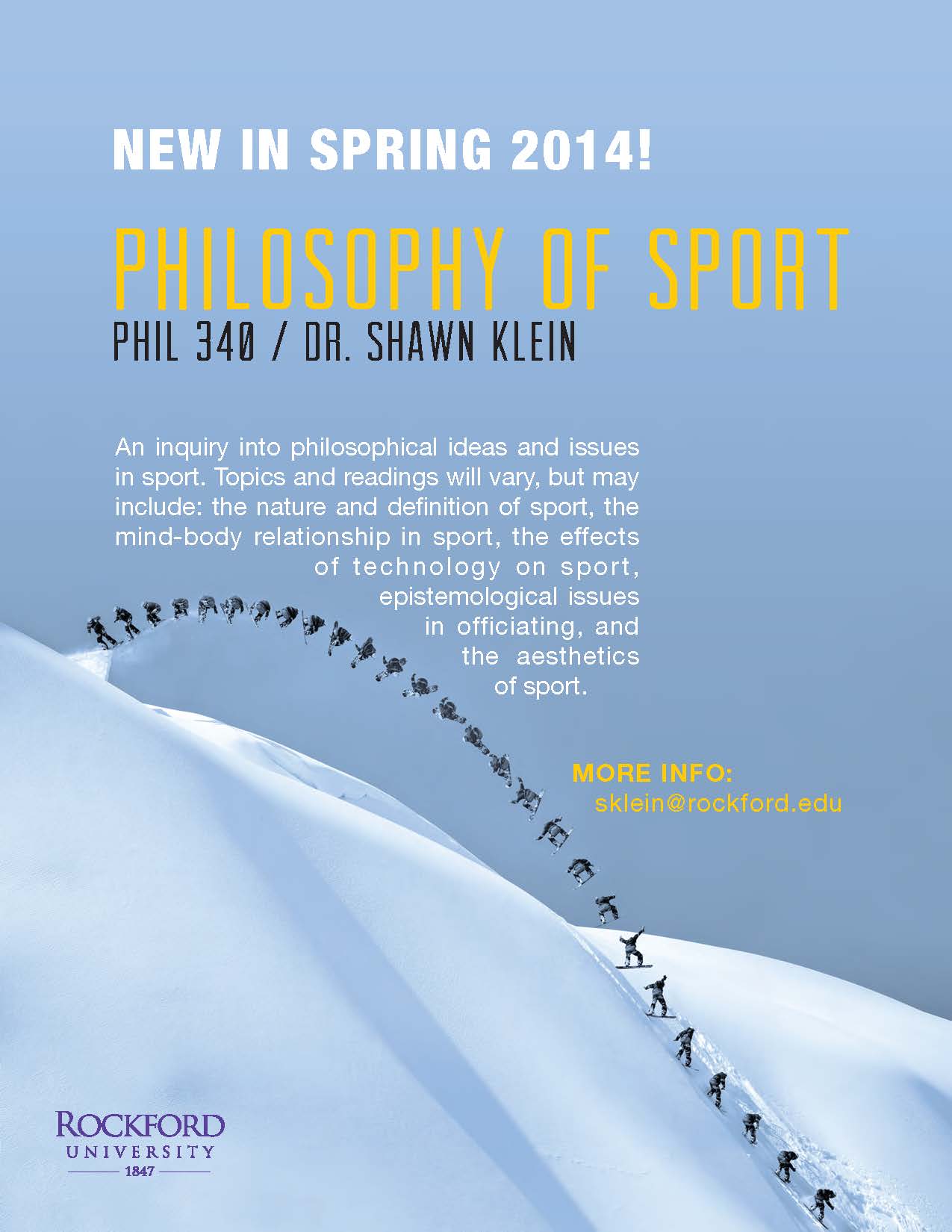
New Course: PHIL 340 Philosophy of Sport

phil of sport-thumb
The Rockford University Philosophy Department is offering a new course this spring: PHIL 340 Philosophy of Sport.

Course Description:

An inquiry into philosophical ideas and issues in sport. Topics and readings will vary, but may include: the nature and definition of sport, the mind-body relationship in sport, the effects of technology on sport, epistemological issues in officiating, and the aesthetics of sport.

The course will be using Heather Reid’s Introduction to the Philosophy of Sport (Elements of Philosophy) as well as supplemental articles from the philosophy of sport literature. The course does carry a pre-requisite of a previous philosophy class. Of course, if you have taken my Sports Ethics class, then you have satisfied this requirement.

The course meets T/TH, 1-2:15 pm. Please contact me if you have any questions about the course.

Leave a comment

Filed under Philosophy, Rockford College, Site Announcements, Sports Studies

Player vs Theory

One of the more common experiences of teaching sports ethics is the eye-rolling response of students. The theoretical account of some issue (e.g. intentional fouls or the proper ends of sports) is met with a cynical glare or what I call the “yeah, but…” response. As in: “Yeah, sounds good in theory, Prof, but that’s not the way it really works.”

For example, Robert Simon defines sport as “the mutual quest for excellence.” On this view, athletes and participates are guided, constrained, and motivated by this cooperative quest for achievement and excellence at the skills and practices of the sport. Overly aggressive play or cheating undermine this quest and so are prohibited. Players play hard in order to achieve their own excellences but also to provide the challenge to their opponents so that they might be pushed to achieve their excellences. There is a lot appealing about Simon’s account. I particularly like the emphasis on the fundamental cooperative nature of athletic competition. But a common student response is “Yeah, that sounds all nice and such, but I play to win. Excellences, challenges, whatever: I want to win.”

Or, in the discussion of intentional fouls, we discuss the range of principles that theorists like Simon and Fraleigh argue ought to constrain a player’s actions in regard to intentional fouls. While Fraleigh is far more restrictive than Simon and others, most share the view that there is something wrong when a player strategically uses explicitly prohibited actions to gain an advantage or negate an opponent’s advantage. The typical student-athlete response is again “Yeah, that sounds all nice and such, but I am going to do what it takes to win the game.”

This might just be that the typical student is unwilling to move from or challenge their pre-reflective beliefs, that they are too cynical or too uncritical to consider accounts that defy the standard narrative. There is a lot of truth to that (a lot!). But at the same time, I think there is something more going on here that needs attention.

While I see this phenomenon in most of the philosophy classes I teach, it is more acute in Sports Ethics. Most of the students are or have been serious athletes. Unlike say in business ethics or biomedical ethics where the students have little or no direct experience with the issues being discussed, the students in sports ethics have a lot of practice in the field under examination. This gives the students a perspective that is typically not there in with students in other classes. (For example, I see something similar when I teach business ethics in my school’s degree completion program where I have students who are already in the business world.)

When the disconnect between students and theory occurs here, it suggests to me something more than mere student stubbornness. These students are practitioners. They may not have given the issue a lot of deep thought, but it is not something new to them. They have views on the issue at hand that have developed from experience, not just the floating uncritical acceptance of a social norm (like minimum wage laws help the poor or everyone ought to vote). Dismissing the rejection of the theoretical-norm as mere cynicism or lack of reflection potentially misses something important.

This is not to argue that we merely ought to accept the player-norms. That would be to shift philosophy to something just descriptive. But I think philosophers and theoreticians ought to pay attention when practitioners in the fields they are analyzing reject the theories. This could point to errors in the theory or a misunderstanding of the practice by the philosophers. It might very well just be student cynicism or lack of criticalness but we don’t really know that unless we look more at the rejection by the players.

Practitioners, too, should pay attention to the theory and not just assume that because they play sports they know what the best account is. Where the theory conflicts with their own practice, it might point to ways in which one is mistaken about their own norms. At the very least, it provides an opportunity for the player to consider in new light what is that he or she is doing.


Leave a comment

Filed under Philosophy

Defining Competition

As part of a recent seminar, I went through the exercise of creating a genus-species definition of competition. A couple of interesting questions were raised by the discussion of the definition, so I am posting the definition exercise along with some elaboration points.

Definiendum: Competition
Examples of particular units of concept:

  • Monopoly, Battleship, Chess, Checkers (Games)
  • Baseball, football, sports, foot races, etc. (Sports)
  • AT&T and Verizon; Apple and MS; (economic)
  • Job applicants for a job/promotion. (economic)
  • Presidential election (political)
  • Chopped, Survivor. (entertainment)

Contrast Objects from which to discriminate units:

  • Two males in a herd battling for dominance (Biological)
  • Two different species of cats in same location, same prey (Biological)
  • War
  • No-elimination Musical Chairs
  • Group ride (bikers touring); fishing, hunting.
  • Singing games: ring around the rosy, etc.

Genus:
Activities involving multiple parties

Differentia of the units with respect to the contrast objects or the characteristics the units have in common (and that the contrast objects don’t have):

  • Goal is exclusive/rivalrous: cannot be held in common or shared among the parties
  • Means are constrained by some set of rules or guidelines.
  • Participation is also constrained by these.
  • Rules, guidelines are acknowledged or agreed to (at least implicitly) by parties.

Definition:
Competition is an activity involving multiple parties that are attempting to achieve an exclusive goal, one which cannot be held in common or shared among the parties, and in which there are some set of rules, guidelines, or constraints on the means for participating and achieving the goal.

A few points of elaboration
I have included economic competition as unit of this concept. A possible objection here is that in economic competition, between two businesses or between two applicants for a job, is not bound by rules. Nevertheless, there are normative constraints on one’s actions in these contexts and to some degree these are agreed upon (legislation). No doubt these are different than the rules of a game, yet they are similar enough to be classed together.

This definition leaves out “biological competition.” This seems justifiable because although it is sometimes described as a kind of competition, it is sufficiently different from these other activities that biological competition is picking out something very different in the world. Some of what we say about competition as it exists in sports, business, and politics cannot apply to the biological: is their unfair competition between two types of fungi? Do we really think of the surviving species as “winning”? The use of competition to describe these biological interactions strikes me as more metaphorical.

At the same time, I can see the basis for the following objection (raised by William Thomas). I ought to identify, instead, a general concept of competition that subsumes both the biological interactions and the kinds of competition I have picked out. In that case, the definition is just: “Competition is an activity involving multiple parties that are attempting to achieve an exclusive goal, one which cannot be held in common or shared among the parties.” The further differentia of “in which there are some set of rules, guidelines, or constraints on the means for participating and achieving the goal” would identify a subset of the concept.

I am somewhat sympathetic to this objection. There does seem to be a more general idea of an activity of parties vying for some good or goal. Some of these activities are governed by some set of rules and others might not. Part of conceptual analysis here is to figure out what makes more sense as “competition.” I think I would be more sympathetic if there were more examples outside of biological competition that illustrated activities of parties vying for some goal independent of any set of rules.

A similar objection might be raised about characterizing war as competition. Might this be another member of the more general genus? Whatever superficial similarities there might be, the activities and goals of war are quite a different thing than anything one finds in sports or games (or business or politics or even biological interactions). I am not sure it belongs in the same genus or even nearby conceptual space. The goal is the death and destruction of your enemy (the prey of a predator is only metaphorically an enemy). There is no necessity of agreement on rules, means, or even on particular goals. It can persist without any particular actions of either other party. It can exist without any response from one party (e.g. an aggressor makes war on a pacifistic village). The use of competition here is much more clearly metaphorical. There is little conceptual gain, efficiency, or clarity by grouping these kinds of things together.

(Note: this definition method is one based on Ayn Rand’s account of definitions in Introduction to Objectivist Epistemology and developed by David Kelley and William Thomas)

4 Comments

Filed under competition, Philosophy